Flow Batteries vs Lithium-Ion: Which Wins for Long-Duration Storage?
What is the practical question?
Flow batteries and lithium-ion batteries both store power. They do not solve the same job. Lithium-ion is often best when space is tight and the backup window is short. Flow batteries start to make sense when the job lasts many hours and repeats often.
Do not start with the chemistry name. Start with the job. Ask how many kW you need. Ask how many hours it must run. Ask how much room you have. Ask who will service the system after year five.
For most homes, lithium-ion is still the easy path in 2026. Products exist. Installers know them. Permits are more familiar. For a campus, farm, utility site, data center, or microgrid that needs 8 to 12 hours, flow batteries deserve a real quote.
Quick decision table
| Decision factor | Lithium-ion usually fits | Flow battery usually fits |
|---|---|---|
| Best duration | 1 to 4 hours, sometimes longer | 6 to 12+ hours |
| Space | Wall, garage, pad, or container | Larger pad with tanks and service room |
| Power response | Very fast | Fast enough for many storage jobs |
| Energy expansion | Add more battery modules | Add tank volume or electrolyte in some designs |
| Service style | Battery packs and controls | Pumps, tanks, stacks, sensors, and fluid checks |
| Best buyer | Home, short backup, peak shaving | Microgrid, campus, utility, long solar shift |
| Main risk | heat, fire code, capacity fade | footprint, service skill, vendor support |
If the job is only a few hours, start with lithium-ion. If the job is a long daily run and the site has room, compare flow batteries before adding more lithium packs.
Plain answer for buyers
Use lithium-ion when the system must be small. Use it when you need a known product now. Use it when local help matters more than the last point of cycle life.
Use a flow battery when the system has room to breathe. Use it when the job is long. Use it when the battery will work hard day after day. Use it when service access is part of the plan, not an afterthought.
A simple home backup job is not the same as a night-long solar shifting job. A shop that only needs two hours of peak shaving is not the same as a remote site that must run through a long outage. The best battery is the one that fits the duty cycle.
How long is long-duration storage?
Many planners call a system long duration when it can run for about 10 hours or more. The exact line can vary. The point is simple. Cost changes as the hour count rises.
Use this formula first:
duration hours = usable energy kWh / rated power kW
A 1,000 kWh system that delivers 250 kW runs for about 4 hours. A 2,500 kWh system that delivers 250 kW runs for about 10 hours. Set the kW target and the hour target before you compare bids.
A common error is buying enough kWh but not enough kW. Another error is buying enough kW but too little usable energy. Ask for both numbers in writing.
Why lithium-ion often wins first
Lithium-ion wins many projects because the market is mature. The gear is common. The quote format is familiar. Installers know the steps. Lenders and insurers have seen the systems before.
That does not make lithium-ion best for every site. It makes it easier to buy. That matters for homes, small firms, EV charging support, and short peak-shaving work.
The weak point is long daily discharge. More hours often mean more cells, more heat control, more floor area, and more future replacement cost. The system can still work. It may not be the best long-term fit.
Why flow batteries can win later
A flow battery stores energy in liquid electrolyte. The fluid moves through a stack. In many designs, the stack relates to power. The tanks relate to energy.
That split can help a long-duration project. If the site already has room for tanks, pumps, and service access, extra hours may be easier to add. The owner can also inspect major parts instead of treating the whole system as a sealed pack.
Flow batteries are not magic. They still need good design. They need pumps, sensors, controls, safe fluid handling, and a service plan. They are strongest when the buyer wants long cycle life, deep daily use, and a system that can be maintained like site equipment.
What should a buyer measure first?
Start with six inputs:
- Required power in kW.
- Required run time in hours.
- Daily or weekly cycle count.
- Available footprint and service clearance.
- Heat, cold, flood, and ventilation limits.
- The value of backup power or stored energy.
Then calculate the useful energy target:
usable kWh = required kW x required hours
If a site needs 500 kW for 10 hours, the useful target is 5,000 kWh. The nameplate size must be higher than that. Losses, reserve settings, age, and operating rules all reduce useful output.
Where lithium-ion is the practical winner
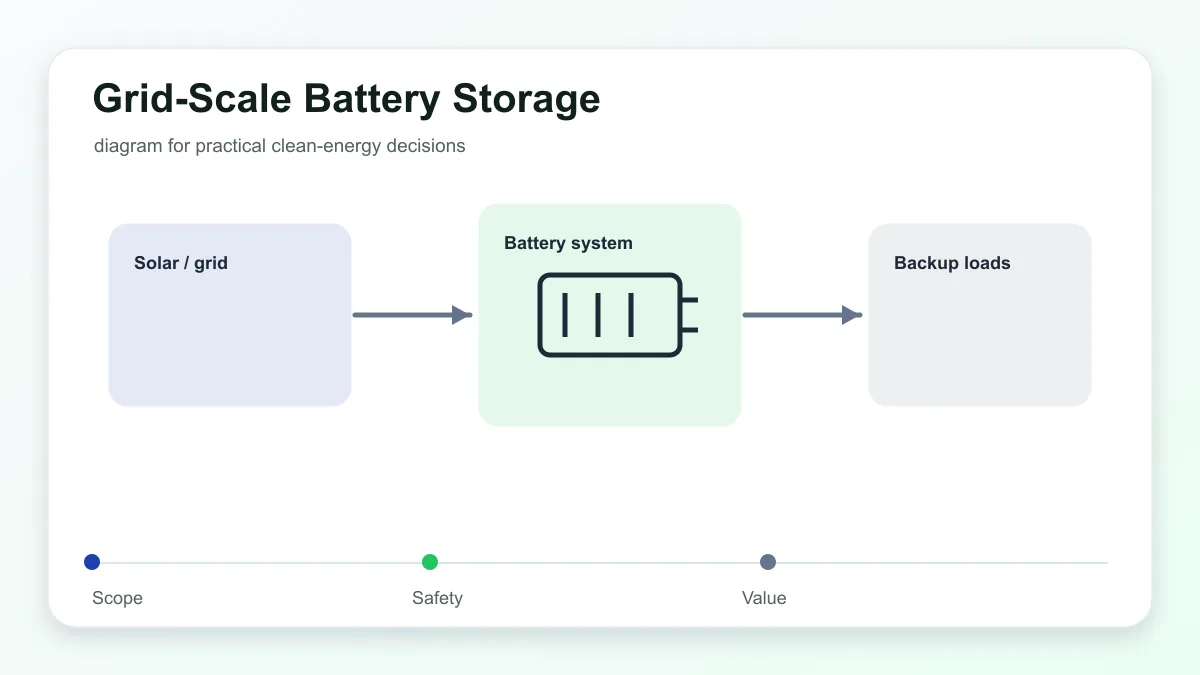
Lithium-ion is usually the first choice for homes. It also fits many small commercial sites. It works well for short backup, demand charge control, and solar shifting for a few evening hours.
It is a good fit when space is limited. It is a good fit when the schedule is tight. It is a good fit when you need many local installers and a clear warranty path.
A home battery may sit idle most days. That is fine. Its value may come from outage protection, not daily grid work. In that case, a compact lithium-ion system can be the most practical answer.
Where flow batteries may win
Flow batteries deserve a deeper quote when the run time is long and cycling is frequent. They can fit solar sites that need to carry power into the night. They can fit remote microgrids. They can fit campuses and industrial sites with room for larger equipment.
They may also help when the owner wants a different safety profile than a large lithium-ion field. Still, the full site matters. Tanks, pumps, controls, containment, parts, and vendor support are part of the cost.
Do not buy a flow battery as a novelty. Buy it because the run time, site, and service model fit.
Cost: what number should you compare?
Do not compare only dollars per nameplate kWh. Compare the cost of useful service.
A fair comparison includes:
- Installed system cost.
- Useful capacity after losses and reserve.
- Round-trip efficiency.
- Capacity or service plan at year 10.
- Maintenance contract cost.
- Replacement parts.
- End-of-life handling.
- Downtime cost.
Lithium-ion may look cheaper at purchase. Flow batteries may look better if the site needs long hours every day. The opposite can happen if the flow project needs heavy site work or weak local support.
Safety and permits
Both options need professional design. Lithium-ion needs fire code review, spacing, heat control, battery management, and emergency labels. Flow batteries need leak control, pipe checks, safe fluid handling, electrical isolation, and service access.
For a home, use listed equipment and qualified installers. For a commercial site, ask for the code basis, test plan, emergency plan, and maintenance record.
A safer chemistry claim is not a permit. It does not remove shock risk. It does not remove chemical risk. It does not remove lifting, flood, heat, or access risk.
Common mistakes
The first mistake is forcing lithium-ion into a 10-hour job without checking other options. The second mistake is assuming a flow battery wins every long job. Site work and service can change the answer.
The third mistake is ignoring power. A system with enough kWh can still fail if it cannot deliver enough kW. The fourth mistake is ignoring efficiency. Losses matter when the energy has high value.
The fifth mistake is comparing uneven quotes. One bid may include fire work, civil work, controls, and service. Another may price only the core unit. Normalize the scope before choosing.
A simple selection rule
Use this rough rule before detailed engineering:
- Choose lithium-ion first for 1 to 4 hour jobs, compact sites, home batteries, and mature installer support.
- Compare both for 4 to 8 hour jobs, especially with frequent cycling.
- Give flow batteries a serious look for 8 to 12+ hour jobs, large sites, microgrids, campuses, and daily renewable shifting.
Then test the rule against the real limits: land, permits, warranty, service, efficiency, safety, and the cost of failure.
What should be in a good RFP?
Ask every vendor for the same facts:
- Rated power.
- Nameplate energy.
- Warranted useful energy.
- Duration at the required kW output.
- Efficiency under the expected use case.
- Capacity or service plan through year 10.
- Site footprint and access limits.
- Fire, chemical, and electrical safety documents.
- Installed cost with exclusions listed.
- Maintenance schedule and response time.
If vendors cannot answer in writing, the project is not ready for a chemistry choice.
Practical recommendation
For most homes and small firms, lithium-ion remains the practical winner in 2026. The product path is mature. The install path is clear. The service path is easier to find.
For grid, campus, industrial, and microgrid sites, flow batteries should be compared when the real run time moves toward a full workday or overnight period.
The right answer is not a slogan. Match the battery to the duty cycle. Start with kW, kWh, space, safety, service, and total cost. Then choose the system that can do the job for the full life of the project.
References
Related Articles