Green Hydrogen vs Batteries: Complementary or Competing?
What is the real decision?
Green hydrogen and batteries are often framed as rivals. That framing is too simple. A person choosing backup power, a facility manager planning resilience, or a developer sizing renewable storage is not choosing a mascot. They are choosing a tool for a specific job.
Batteries are usually better when electricity must be stored and returned within minutes, hours, or a normal daily cycle. Green hydrogen starts to matter when the storage period stretches into many hours, days, weeks, or seasonal use. The break point depends on price, site rules, safety, efficiency, and the value of reliable power.
The practical question is this: do you need short-duration electricity storage, or do you need a fuel-like energy carrier that can sit for longer periods?
Quick answer
For most homes and small businesses, batteries are the practical winner today. They are compact. They are efficient. They are easier to buy. They can pair with solar and support critical loads during outages.
Green hydrogen is not usually the first choice for a house. It needs an electrolyzer, water, storage, controls, ventilation, safety systems, and a fuel cell or engine to turn hydrogen back into electricity. That is a lot of equipment for a small load.
For larger sites, the answer changes. Green hydrogen may fit where the storage need is long, the site has space, renewable electricity would otherwise be curtailed, and the owner can manage industrial safety. Batteries and hydrogen can also work together. Batteries handle fast response. Hydrogen handles long reserve.
Decision table
| Use case | Battery usually fits | Green hydrogen may fit |
|---|---|---|
| Home backup for a few hours | Strong fit | Usually too complex |
| Overnight solar shifting | Strong fit | Possible but often inefficient |
| 1 to 4 hour grid support | Strong fit | Usually not first choice |
| 8 to 24 hour microgrid backup | Compare options | Worth modeling |
| Multi-day outage reserve | Expensive if all battery | Possible at larger scale |
| Seasonal renewable storage | Usually weak fit | Stronger candidate |
| Industrial fuel and power | Limited role | Stronger candidate |
| Fast frequency response | Strong fit | Weak fit |
If the job needs fast, efficient cycling, start with batteries. If the job needs long storage time, fuel flexibility, or seasonal reserve, hydrogen deserves a closer look.
Why batteries win many real projects
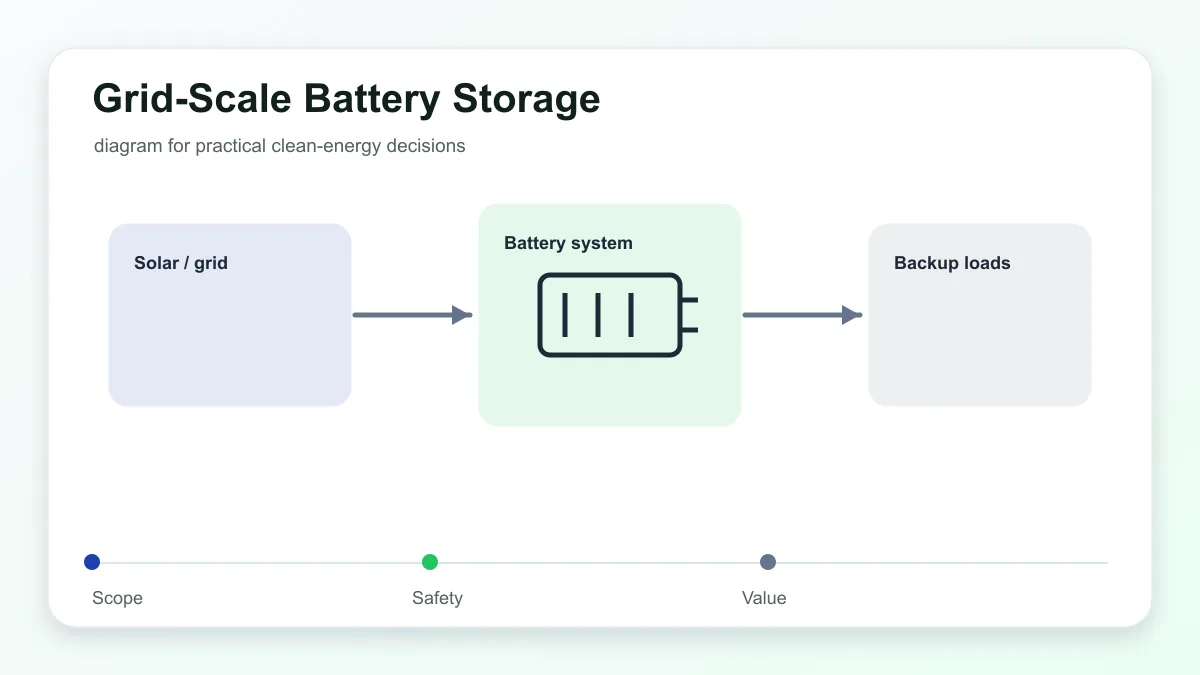
Batteries are direct. Electricity goes in. Electricity comes out. The round-trip efficiency is usually much higher than a hydrogen pathway. The system can respond quickly. The equipment is widely available.
That matters for homes, solar owners, EV charging sites, and commercial peak shaving. A battery can charge in the afternoon and discharge in the evening. It can ride through a short outage. It can reduce demand spikes. These are common, concrete jobs.
Batteries also have a clearer buying path. A buyer can compare kW, kWh, warranty, chemistry, installer support, and backup-load panels. The project can still be complex, but it is not usually an industrial gas project.
Where batteries struggle
Batteries get harder when the storage window grows. A four-hour system may be reasonable. A 12-hour system may still work. A multi-day system can become large and expensive.
The issue is not only first cost. It is also space, fire code, thermal management, replacement planning, and how often the battery sits full or empty. If the battery is used heavily every day, degradation matters. If it is used only for rare outages, the owner may be paying for hardware that waits most of the year.
For a remote site that needs several cloudy days of reserve, a pure battery plan can become bulky. For seasonal storage, batteries are usually a poor match because they are costly assets to leave idle for long periods.
Why green hydrogen matters
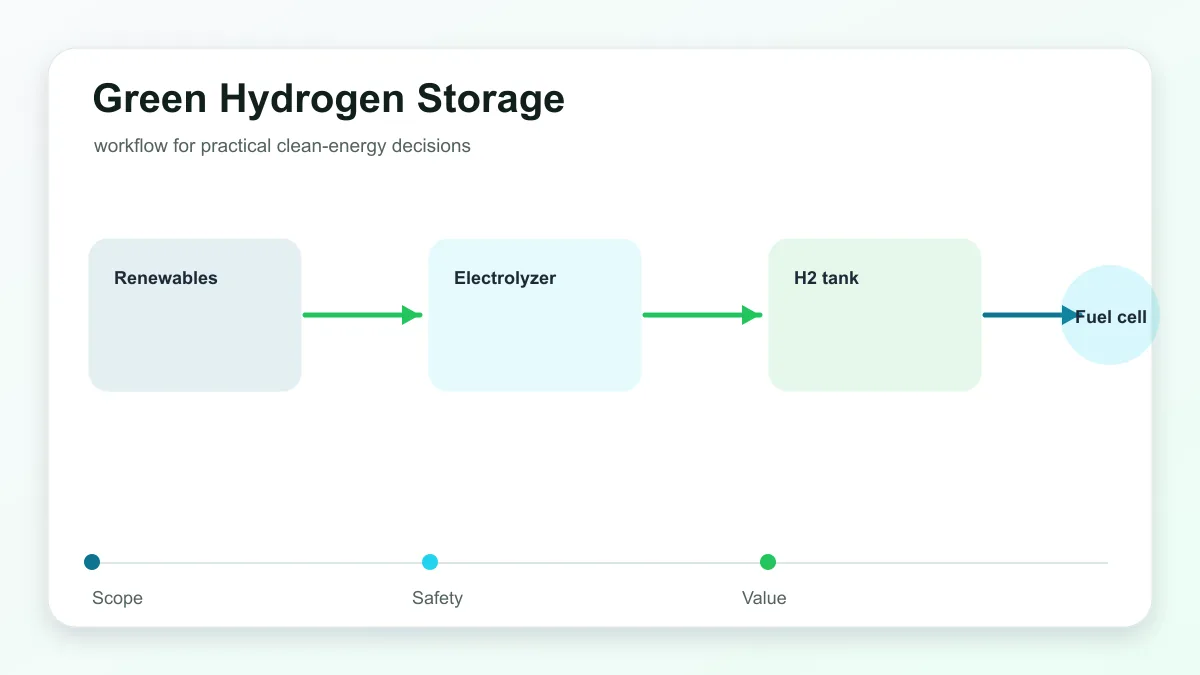
Green hydrogen is made by using renewable electricity to split water into hydrogen and oxygen. The hydrogen can be stored and later used in a fuel cell, turbine, engine, or industrial process.
That makes it more like a fuel than a short-duration battery. Hydrogen can be useful when the energy needs to move across time, distance, or sectors. It can support hard-to-electrify industrial uses. It can also store renewable energy when supply is high and demand is low.
For electricity-only use, hydrogen has a major weakness: efficiency. Making hydrogen, storing it, and turning it back into electricity loses a lot of energy. That is why batteries usually win short daily cycling.
The duration threshold
Use duration as the first filter:
required energy kWh = required power kW x required hours
A home that needs 3 kW for 10 hours needs about 30 kWh of useful energy. A commercial site that needs 500 kW for 48 hours needs 24,000 kWh. These are very different problems.
For short durations, the battery path is usually simpler. As the duration grows, hydrogen may become more attractive because adding fuel storage can be easier than adding many more battery containers. The exact break point must be modeled with local costs and site rules.
Efficiency tradeoff
Efficiency is the main reason hydrogen should not replace batteries for every use. A battery can return a large share of the electricity it stores. A hydrogen system loses energy during electrolysis, compression or storage, and conversion back to electricity.
That does not make hydrogen useless. It means hydrogen must solve a problem where duration, fuel value, or sector coupling is worth the loss. If the only goal is to shift solar from noon to evening, a battery is usually the cleaner answer.
If the goal is to store excess renewable energy for days, support industrial fuel use, or create a long reserve for a large site, hydrogen may still be worth modeling.
Safety and permitting
Batteries and hydrogen both need serious safety work. Battery projects need fire code review, spacing, thermal management, shutdown procedures, and emergency response planning.
Hydrogen adds gas-specific issues. It is light. It can leak. It needs ventilation, leak detection, pressure management, separation distances, and trained maintenance. Storage method matters. Compressed gas, liquid hydrogen, and chemical carriers each change the risk profile.
For a homeowner, this is a hard boundary. A home battery may be practical with listed equipment and a qualified installer. A home-scale hydrogen system is usually not a simple consumer appliance. Treat it as specialized equipment unless local products, codes, and service support are clear.
What should a buyer measure first?
Before choosing either path, collect these numbers:
- Critical load in kW.
- Required hours or days of backup.
- Daily energy use in kWh.
- Available site area.
- Existing solar or wind output.
- Local electricity rate and demand charges.
- Outage cost per hour.
- Permit and inspection requirements.
- Maintenance skill available on site.
Then write the use case in one sentence. For example: "Run 20 kW of critical loads for 12 hours after storms." That sentence is more useful than saying "we need hydrogen" or "we need batteries."
Home example
A homeowner wants backup for a refrigerator, lights, Wi-Fi, and a few outlets. The load is 1.5 kW at peak and about 12 kWh per night.
A battery system is the practical starting point. It can be installed with a critical-load panel. It can charge from solar. It is quiet. It does not need fuel delivery. It fits the short-duration backup job.
Hydrogen would add too many parts for this case. The owner would need hydrogen production or delivery, storage, a conversion device, and safety systems. The complexity is not justified for a normal home backup need.
Microgrid example
A remote site needs 100 kW for three cloudy days. That is 7,200 kWh before losses and reserve. A pure battery system can work, but it may be large and costly.
This is where a hybrid design may make sense. Batteries can handle fast changes, solar ramping, and short outages. Hydrogen can act as longer reserve if the site can support the equipment and safety plan.
The design question is not battery versus hydrogen. It is how much battery should handle daily cycling, and whether hydrogen should cover rare long events.
Common mistakes
The first mistake is treating hydrogen as a better battery. It is not. It is a different storage pathway with different losses and safety needs.
The second mistake is treating batteries as the answer to every long outage. Batteries are strong, but multi-day and seasonal storage can become expensive.
The third mistake is ignoring maintenance. A battery system needs monitoring and eventual replacement. A hydrogen system needs gas safety, mechanical equipment, and trained service.
The fourth mistake is comparing nameplate energy only. Compare useful delivered energy at the required power level, after losses, reserve, aging, and downtime risk.
Practical recommendation
For homes and small businesses, start with batteries. Add solar, load control, and a critical-load panel before considering hydrogen.
For commercial sites and microgrids, use duration as the first split. Batteries are usually strongest for fast response and same-day cycling. Hydrogen becomes more plausible as backup duration stretches beyond the normal battery window.
For utility and industrial projects, compare them as partners. Batteries can stabilize power. Hydrogen can store energy longer or serve fuel needs. A strong plan may use both.
The best answer is not "hydrogen wins" or "batteries win." The best answer is a design that matches time, power, space, safety, maintenance, and cost.
References
Related Articles