Solar Street Light Calculator: Watts, Lumens, Sun Hours, and Battery Size
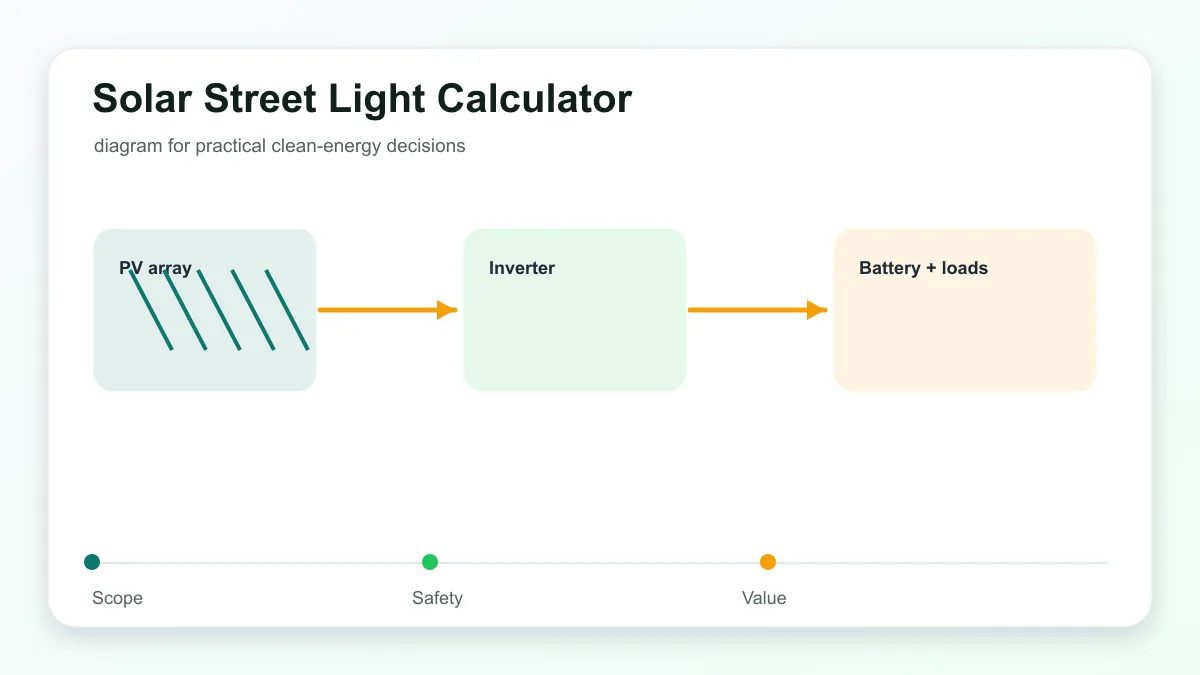
Solar Street Light Sizing Calculator
Estimate fixture watts, panel watts, battery capacity, and cloudy-day reserve from real site inputs.
What should you size first?
A solar street light is not sized by one number. A good system balances light output, nightly run time, winter sun, battery reserve, and the place where the pole will stand. We would not buy by advertised panel watts alone.
Start with the job. A garden path needs a different light than a farm gate or driveway. A parking bay needs more even coverage. A security light may need a motion sensor and a brighter short burst. The calculator above gives a quick estimate, but the static rules below show how to check the result.
Quick answer for common sites
For a short driveway or gate, many homes can start with a 20 W to 40 W LED fixture, a 60 W to 120 W solar panel, and 500 Wh to 1,200 Wh of battery storage. A path light may need less. A small parking area may need more.
Use these ranges as a first screen, not a final design:
| Use case | Typical fixture | Useful lumen range | Common pole height | Battery reserve |
|---|---|---|---|---|
| Garden path | 10 W to 20 W | 1,000 to 2,500 lm | 8 to 10 ft | 1 to 2 nights |
| Driveway or gate | 20 W to 40 W | 2,500 to 5,000 lm | 10 to 16 ft | 2 nights |
| Farm lane | 30 W to 60 W | 4,000 to 8,000 lm | 14 to 20 ft | 2 to 3 nights |
| Small parking bay | 50 W to 100 W | 7,000 to 15,000 lm | 18 to 25 ft | 2 to 3 nights |
If the site gets poor winter sun, size the panel and battery from winter data. Summer sunlight can make a weak system look good for a few months.
How do watts and lumens relate?
Watts measure electrical power. Lumens measure visible light. A modern LED street light may produce about 120 to 180 lumens per watt, but real fixtures vary. Optics, heat, dirt, and low-cost drivers can reduce useful light.
A 30 W LED fixture may produce roughly 3,600 to 5,400 lumens. That can work for many driveways. It may be too dim for a wide parking area. It may be too bright for a narrow path if the pole is low and close to windows.
For buying, look at both fixture watts and lumens. For comfort, also check beam angle and glare control. A bright fixture pointed badly can feel worse than a smaller fixture placed well.
What is the basic energy formula?
Daily energy is simple:
daily Wh = fixture watts x lighting hours x operating factor
The operating factor accounts for dimming and motion sensing. If a 30 W light runs 10 hours and motion dimming saves about 20 percent, the nightly energy is about 240 Wh.
30 W x 10 h x 0.8 = 240 Wh
This number drives both the solar panel and the battery. If you change only one input, the whole system changes. A 12 hour run time needs more storage than an 8 hour run time. A site with 2.5 peak sun hours needs a larger panel than a site with 5 peak sun hours.
How many sun hours are enough?
Peak sun hours are not the same as daylight hours. A cloudy winter day may have many daylight hours but few useful solar charging hours. For solar street lights, winter peak sun hours matter most.
A practical panel estimate is:
panel watts = daily Wh x loss margin / peak sun hours
Use a loss margin of 1.25 to 1.5 for charge controller losses, heat, dirt, wiring, and aging. For the 240 Wh example with 4 peak sun hours and a 30 percent margin:
240 Wh x 1.3 / 4 h = 78 W
That points to an 80 W panel as a minimum. If winter sun is closer to 2.5 peak sun hours, the same light needs about 125 W. That is why many failed lights are not bad products. They are under-sized for winter.
How big should the battery be?
Battery storage must cover one normal night plus any cloudy reserve. The simple formula is:
battery Wh = daily Wh x target nights / usable depth of discharge
Target nights means the normal night plus backup nights. If the light uses 240 Wh per night and you want two cloudy backup nights, target nights is three. With an LFP battery that can safely use 80 percent of its rated capacity:
240 Wh x 3 / 0.8 = 900 Wh
For a 12.8 V battery, that is about 70 Ah:
900 Wh / 12.8 V = 70 Ah
Lead-acid batteries usually need a lower usable depth. Cold weather can also reduce usable capacity. If the light must work through winter storms, do not size the battery from warm-weather claims.
All-in-one or split system?
All-in-one solar street lights are compact. The panel, battery, controller, sensor, and lamp sit in one fixture. They are easy to install and clean for simple sites.
Split systems place the panel away from the lamp. They are better when the light must sit under a tree, beside a wall, or in a shaded corner. They also make battery replacement and panel angle easier in some installs.
Choose all-in-one when the fixture location has clear sun and easy access. Choose split when the best lighting position and the best solar position are not the same place.
What pole height and spacing should you use?
Pole height affects glare, coverage, and shadows. Low poles can work for paths. Driveways and parking bays need higher mounting so the light spreads evenly.
As a rough rule, spacing is often 2.5 to 4 times the pole height for basic area lighting. A 12 ft pole may cover about 30 to 48 ft between fixtures. The right value depends on beam angle and desired uniformity.
Do not stretch spacing until dark gaps appear. Dark gaps are common when buyers focus on fixture lumens but ignore beam pattern.
What mistakes cause most failures?
The first mistake is buying by panel watts alone. The panel only tells you charging potential. It does not tell you how much light reaches the ground.
The second mistake is ignoring shade. Even partial shade can cut daily charging enough to drain the battery over several nights.
The third mistake is using summer sun to size a winter light. A system that works in July may fail in December.
The fourth mistake is treating battery capacity as fully usable. A battery rated at 1,000 Wh may not provide 1,000 Wh in a safe daily cycle.
What maintenance should owners expect?
Clean the panel when dust, pollen, bird droppings, or snow block sunlight. Check the fixture after heavy rain for water inside the lens or battery box. If run time drops every week, test the panel, controller, and battery before replacing the whole light.
A good maintenance schedule is simple:
- Monthly: check panel dirt, shade growth, loose bolts, and lens damage.
- Seasonally: confirm winter run time and sensor behavior.
- Yearly: inspect seals, pole hardware, battery condition, and wiring.
- At battery end of life: replace with the same voltage and compatible chemistry.
When is replacement better than repair?
Replace the battery when the fixture still charges but run time has dropped below the needed hours. Replace the full fixture when the LED driver, housing, seals, and battery are all near end of life.
If a battery costs more than half of a new fixture and the light is already old, full replacement may be more practical. If the fixture is strong and the battery is easy to access, battery replacement often wins.
How should old parts be disposed of?
Do not put lithium batteries in household trash. Remove batteries according to the maker's instructions and use a battery recycling channel. Panels, aluminum housings, poles, and electronics may have separate recycling paths.
If the battery is swollen, leaking, hot, or damaged, handle it as a safety issue. Ask a local waste authority or battery recycler before moving it far.
Practical recommendation
For most home sites, start with the lighting job, not the product listing. Choose lumens for the area, estimate nightly energy, size the panel from winter peak sun hours, and size the battery for at least one normal night plus cloudy reserve.
A driveway example with a 30 W fixture, 10 hours of lighting, 4 peak sun hours, motion dimming, and two backup nights points to about an 80 W panel and about 900 Wh of battery storage. In a darker winter climate, the panel may need to be closer to 120 W or 150 W.
References
Related Articles