Which EVs Support V2G in 2026? Complete Buyer's Guide
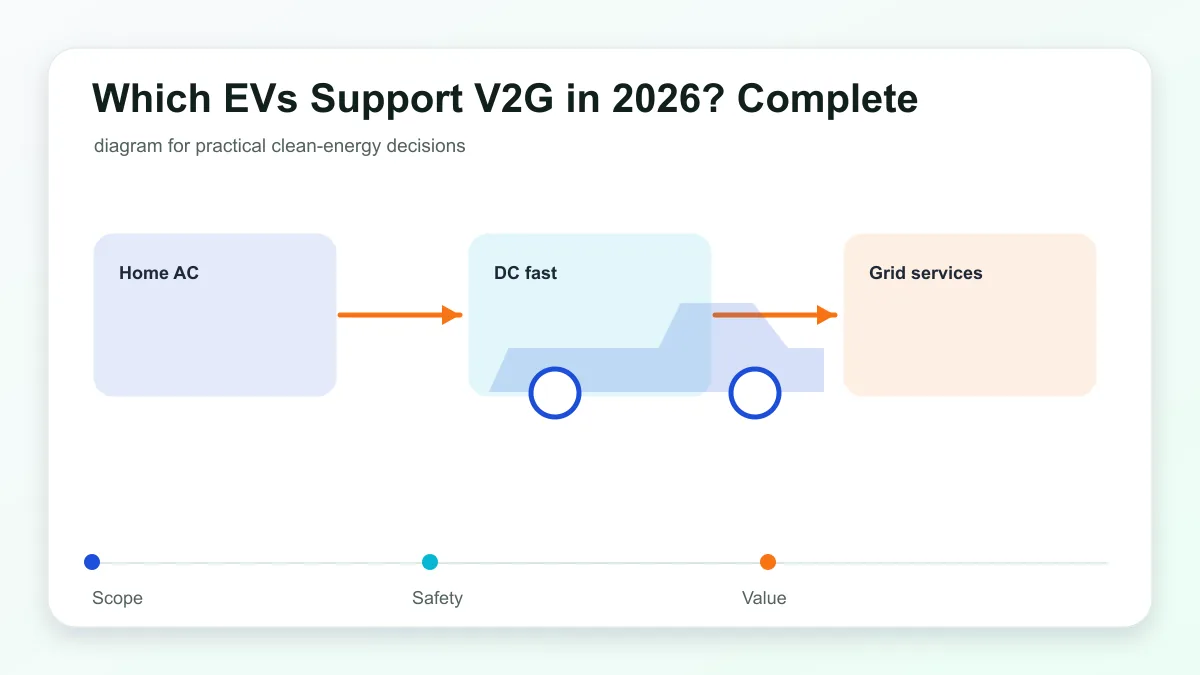
Which EVs support V2G in 2026?
In 2026, V2G support is still uneven. Some EVs can power tools. Some can back up a home. A smaller group can send power to a utility program. We would not treat every two-way power claim as the same feature.
This guide separates three jobs: vehicle-to-load, vehicle-to-home, and vehicle-to-grid. That split matters. The charger can change. The warranty can change. The utility rule and payment model can also change. A car that can run a campsite may not be approved to sell power back to the grid.
What should buyers check first?
Start with the real use case. Backup power needs a transfer switch or a home energy system. Utility export needs a two-way charger, utility approval, and software sign-up. Portable power may only need the adapter that comes with the vehicle.
Check these items before you pay extra for a V2G feature:
- The vehicle must support the two-way mode you need.
- The charger must support the same standard.
- The utility must allow export or demand response.
- The battery warranty should mention two-way use.
- The installer should confirm panel capacity and safe isolation.
If one piece is missing, the car may still help. It just may not deliver true grid export.
Which models are the strongest V2G candidates?
The Nissan Leaf remains the most proven V2G option. CHAdeMO two-way charging has been used in real projects for years. The tradeoff is clear. CHAdeMO is no longer the main growth path for North American EV charging.
The Ford F-150 Lightning is one of the strongest home-backup choices. Its large battery and high power output can support key loads well. The full setup usually needs Ford home hardware and a qualified install.
Hyundai and Kia E-GMP vehicles include the Ioniq 5, Ioniq 6, EV6, and EV9. They are useful for V2L today. They can run tools, small appliances, or emergency loads from an outlet adapter. True grid export depends on market, firmware, charger support, and utility approval.
Some BMW, Volkswagen, and Volvo programs support two-way pilot projects in selected regions. Treat those as promising but local. Ask for the exact program name and charger model before you assume the feature works at your address.
Tesla buyers should be careful with claims. Tesla has discussed two-way power. Yet common Model 3 and Model Y buys should not be treated as ready V2G systems unless the vehicle, charger, and software all support it in writing.
V2L, V2H, and V2G are not the same
V2L means vehicle-to-load. It usually powers a plug, tool, refrigerator, or small appliance. It is simple and useful, but it does not normally connect to the grid.
V2H means vehicle-to-home. It can power a house or selected circuits during an outage. It needs safe isolation from the grid. That usually means a transfer device or a home energy system.
V2G means vehicle-to-grid. It can export energy to the utility system. This is the hardest mode. It needs utility permission, metering, control software, and a tariff or program that pays for the service.
What hardware does V2G require?
A V2G setup needs more than a cable. At minimum, it needs a compatible vehicle, a two-way charger, charger-to-car communication, and an approved electrical design.
For home backup, the system also needs a way to isolate the home from the grid during an outage. For grid export, it needs utility approval and software control. These steps can take longer than the charger install.
Budget planning should include hardware, permits, labor, utility review, and possible panel work. A cheap adapter may support V2L. It should not be confused with a full V2H or V2G install.
What can owners earn from V2G?
The revenue case is still local. In many areas, the best value is backup power and time-of-use shifting. In a few areas, demand response or virtual power plant programs may add direct payments.
A realistic annual value range is often $200 to $600 for a home that can join a useful program. Higher claims may be possible in special markets. They should come with a written tariff, dispatch rule, and payment history.
Battery wear also matters. Shallow cycles are easier on a battery than deep daily cycles. A good program limits depth of discharge. It protects a driving reserve. It also states how the maker treats V2G use under warranty.
Which buyer profile fits V2G best?
V2G is strongest for owners who park at home, have steady driving needs, and live under a utility program that rewards flexible energy. It is also attractive where outages are common and a home battery would cost more.
It is weaker for renters, street parkers, heavy daily drivers, and owners with no export program. In those cases, V2L may still be valuable. Full V2G may not pay back.
The best buyer is not the person chasing the most advanced spec. It is the person whose vehicle, charger, utility, and home wiring all match the same use case.
How should you compare V2G vehicles?
Use a one-page comparison. List battery size, two-way mode, charger need, home-backup support, export approval, warranty language, and installed cost. Then mark each item as confirmed, unclear, or not supported.
Do not compare vehicles by battery size alone. A large battery with no approved export path may be less useful than a smaller vehicle in a real utility program. Also check the minimum reserve setting. You do not want a grid event to leave too little range for the next trip.
Ask the dealer and installer for written answers. Sales pages often mix V2L, V2H, and V2G language. Written model-year details reduce that risk.
What are the main risks?
The first risk is buying a vehicle for a feature that only works in another region. The second risk is buying a charger before the utility approves the design. The third risk is assuming export revenue will stay fixed for the life of the car.
There is also a standards risk. CHAdeMO has the longest V2G history. CCS and NACS paths are still developing in many markets. A buyer should care less about the acronym and more about confirmed local support.
Warranty terms need close review. Look for language on two-way cycling, battery throughput, and grid dispatch. If the warranty is silent, ask the maker before joining heavy cycling programs.
What is our practical recommendation?
For most 2026 buyers, choose the EV first for driving needs and total cost. Treat V2G as a useful second feature. It can be a strong bonus when the local utility and charger market are ready.
If backup power is the main goal, compare the EV setup against a home battery and a standby generator. If revenue is the main goal, ask for the exact program payment and dispatch rules before buying hardware.
Our simple rule is this: do not pay a large premium for V2G unless the vehicle, charger, installer, utility, and warranty all support the same two-way use case.
References
Related Articles