Energy category
Energy Storage
Home and grid-scale battery storage, lithium-ion, LFP, and emerging technologies
Published
What is already useful about energy storage?
Start with the guides that already have a complete answer contract, then move into the planned topic layers.
Category guide
How should a reader think about energy storage?
This category overview keeps the technical context connected to a household or project decision.
Why Is Energy Storage Critical for Renewables?
Solar and wind are intermittent — they produce power when the sun shines and wind blows, not necessarily when demand peaks. Energy storage bridges that gap by storing excess generation and discharging later. The right system depends on power, duration, cycling, safety, and service access.
Lithium-ion batteries dominate stationary storage, with LFP chemistry valued for safety and cycle life. For a deep-dive on grid-scale technologies, see our grid-scale battery storage guide.
Home Battery: Is It Worth It?
Home battery value depends on outage risk, utility rate structure, solar exports, installation cost, and replacement risk. Time-of-use arbitrage can matter, but the result changes by utility. Our home battery costs guide provides payback analysis, while the home battery comparison covers options.
What Comes Beyond Lithium?
Flow batteries, iron-air batteries, compressed air, thermal storage, and hydrogen target longer-duration applications. Our hydrogen storage guide and flow battery comparison explain where those technologies fit.
Build depth
T2 Deep Dives
Planned and supporting pages in the T2 layer.
T2
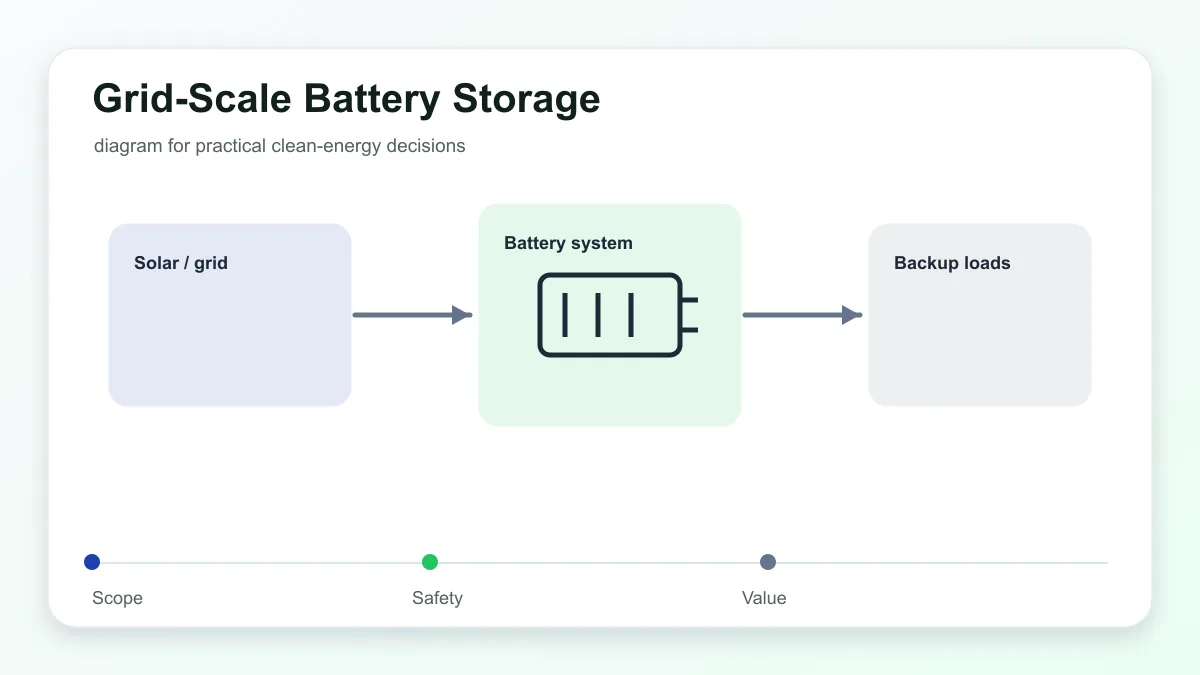
Grid-Scale Battery Storage: Technologies and Economics
Utility-scale battery storage systems — lithium-ion, flow batteries, and emerging technologies for grid stabilization.
T2
Hydrogen Energy Storage: Green Hydrogen for Seasonal Storage
Green hydrogen production, storage, and conversion for long-duration and seasonal energy storage applications.
T2
Battery Storage Safety: Fire Prevention and Installation Standards
Fire prevention, installation standards, emergency protocols, and safety certifications for home battery systems.
Make the comparison
T3 Summaries
Planned and supporting pages in the T3 layer.
T3
Flow Batteries vs Lithium-Ion: Technical Comparison
Compare flow battery and lithium-ion technologies for stationary energy storage — efficiency, lifespan, cost.
T3
Thermal Energy Storage: Phase Change Materials for Homes
Phase change materials (PCM) for home thermal energy storage — heating, cooling, and load shifting.
T3
Home Battery Lifespan: Real-World Degradation Data
Real-world degradation data for home batteries — cycle life, calendar aging, and chemistry comparison.
Answer one narrow question
T4 Quick Reference
Planned and supporting pages in the T4 layer.
T4
Second-Life EV Batteries for Home Storage
Using repurposed EV batteries for stationary home energy storage — costs, performance, and safety considerations.
T4
Battery Recycling and Disposal Guide
End-of-life management for lithium-ion batteries — recycling technologies, regulations, and environmental impact.