Energy category
Smart Grid
Smart grids, virtual power plants, demand response, and AI-driven energy management
Published
What is already useful about smart grid?
Start with the guides that already have a complete answer contract, then move into the planned topic layers.
Category guide
How should a reader think about smart grid?
This category overview keeps the technical context connected to a household or project decision.
What Makes a Grid Smart?
Unlike a traditional one-way grid, a smart grid uses sensors, two-way communication, and automated control to optimize electricity flow. Key components include smart meters, distribution automation, and grid management systems that can respond to demand changes.
Smart grids enable real-time pricing signals, automated fault detection, and integration of distributed resources such as solar, batteries, and EVs. The household question is usually simpler: which signal or program changes the bill, comfort, or backup plan?
How Do Virtual Power Plants Work?
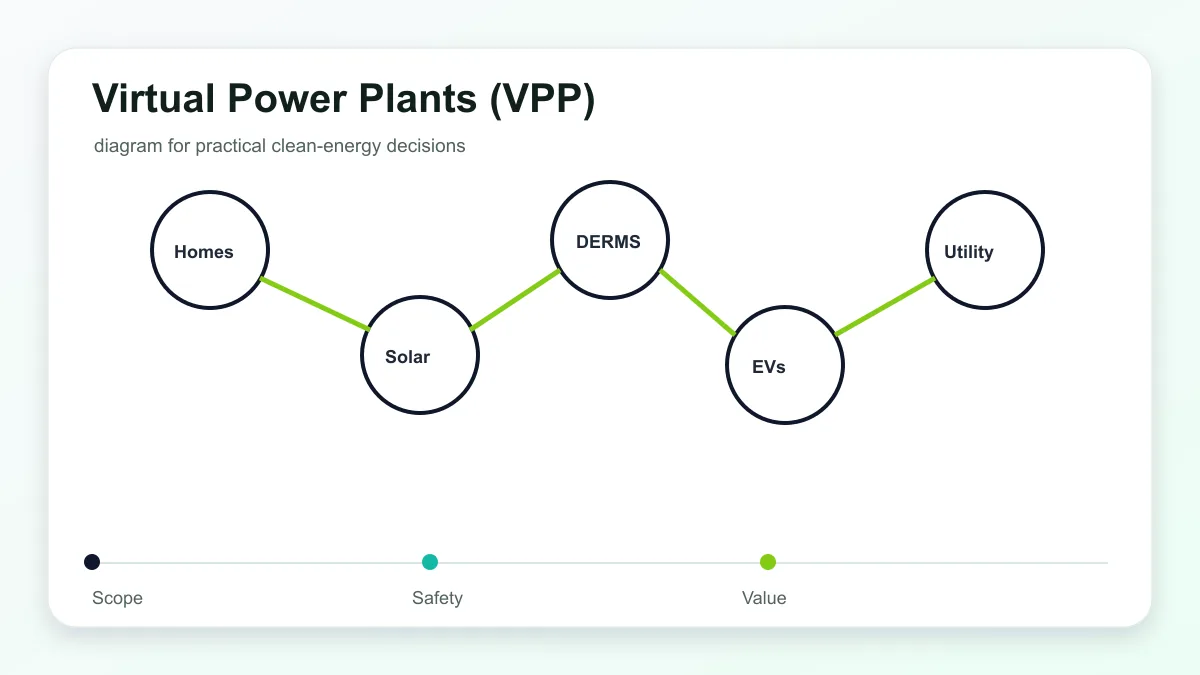
Virtual power plants aggregate home solar systems, batteries, and EVs so they can provide grid services as a coordinated resource. Participation depends on the utility, aggregator, equipment, export rules, and compensation terms. Our VPP guide explains the decision path.
Can Demand Response Pay for Itself?
Demand response programs may pay homeowners to reduce consumption during peak periods. Before enrolling, check event limits, override rules, comfort impact, data access, and the actual annual payment. See the demand response guide.
Build depth
T2 Deep Dives
Planned and supporting pages in the T2 layer.
T2
Smart Grid Technology: The Future of Energy
How smart grids modernize electricity distribution with IoT, AI, real-time monitoring, and bidirectional power flow.
T2
Virtual Power Plants (VPP): Aggregating DERs
How VPPs aggregate solar, battery, and EV resources to participate in energy markets and provide grid services.
T2
Demand Response Programs: How Smart Homes Participate
How smart home devices enable automated demand response participation — savings, incentives, and technology requirements.
Make the comparison
T3 Summaries
Planned and supporting pages in the T3 layer.
T3
Microgrids vs Smart Grids: Understanding the Difference
Compare microgrid and smart grid architectures — islanding capability, control systems, applications, and real-world deployments.
T3
Smart Home Energy Management: Saving 10-30%
Smart thermostats, energy monitors, and automated load control to reduce home energy consumption by 10-30%.
Answer one narrow question
T4 Quick Reference
Planned and supporting pages in the T4 layer.
T4
Time-of-Use Rates: How to Optimize Your Energy Usage
Understanding TOU rate structures and strategies to shift consumption to off-peak hours for maximum savings.
T4
Grid-Interactive Buildings: The Future of Energy-Efficient Construction
How grid-interactive efficient buildings (GEBs) use smart controls, on-site generation, and storage to optimize energy use.