Solar LED Light Panel and Battery Sizing: Watts, Wh, and Runtime
What problem are we solving?
A solar LED light can miss runtime by 50% when panel watts and battery Wh are guessed. We recommend sizing from nightly energy first. Then check winter peak sun hours, usable battery depth, dim mode, and backup nights.
Here is my take: the page should answer the field decision first. The keyword solar led light panel is the search entry. It is not the outline. The outline follows the buyer, owner, or installer who needs a working light in a specific place.
What should you check first?
Check the use case before the product title. A path light, garden light, motion security light, street light, and parking lot fixture solve different problems. The same solar LED light can be good in 1 setting and weak in another.
| Use case | Practical screen | What to check |
|---|---|---|
| Small path light | 5 W x 8 h | 40 Wh per night |
| Gate light | 12 W x 8 h | 96 Wh per night |
| Security light | 20 W x 10 h | 200 Wh per night |
| Street fixture | 50 W x 10 h | 500 Wh per night |
Which specs change the decision?
Use the table as a buying filter. If a listing hides 2 or more core specs, hold it for review. Brightness claims are not enough. Battery Wh, panel watts, IP rating, mounting height, and sensor mode decide whether the fixture lasts through winter.
| Spec | Minimum useful check | Why it matters |
|---|---|---|
| LED load | actual watts | Sets nightly energy use |
| Solar panel | watts and exposure | Sets daily recharge |
| Battery | Wh, voltage, chemistry | Sets runtime and reserve |
| Housing | IP65 or better | Reduces rain failure |
| Mounting | height and aim | Controls glare and dark gaps |
| Controls | dim or motion mode | Changes runtime by hours |
How do you size it?
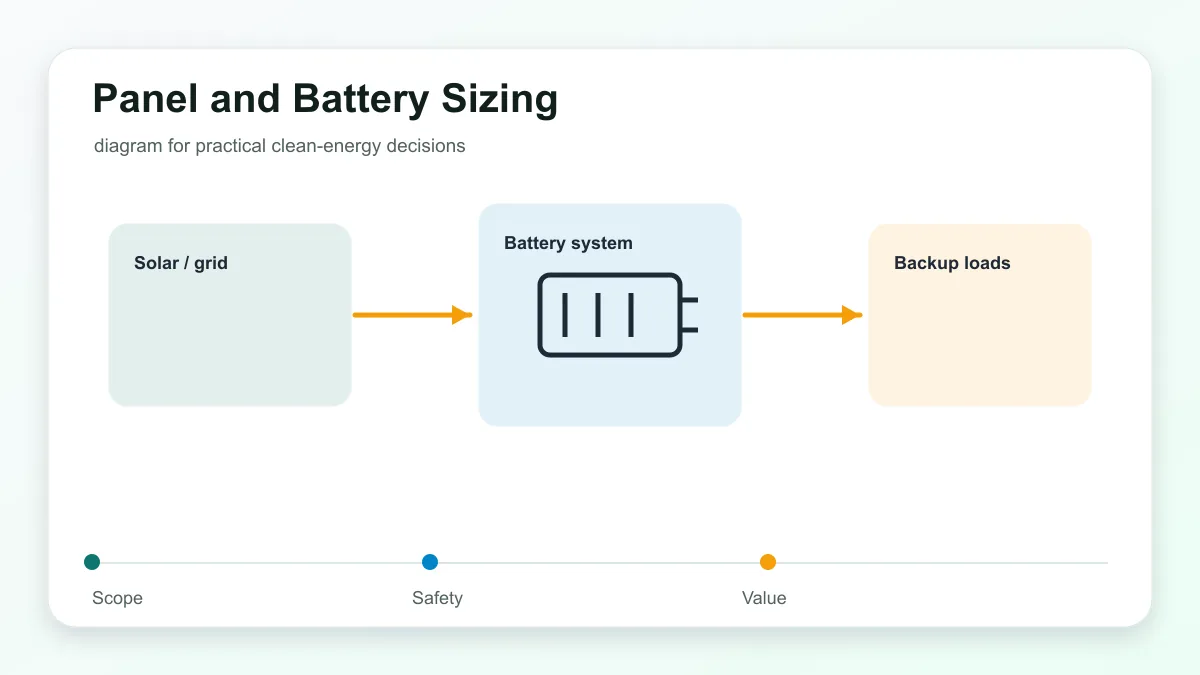
Formula: daily Wh = LED watts x hours x operating factor. Panel watts = daily Wh x 1.3 / peak sun hours. Battery Wh = daily Wh x reserve nights / usable depth.
Do not use summer sun as the only input. Use the darker season if the light must work all year. Shade can erase the benefit of a larger panel. A small amount of shade on the panel can cause a large runtime loss.
What failure risk is easiest to miss?
Worked example: a 30 W light runs 10 hours with dimming that saves 20%. Daily use is 240 Wh. With 4 peak sun hours, panel size starts near 78 W. With 2.5 winter sun hours, it starts near 125 W.
Cost matters, but cheap fixtures become expensive when they fail in the first season. We recommend rejecting a product when it has no battery Wh, no panel watts, no IP rating, no warranty, or no clear replacement path.
What would I verify in the field?
Field note: keep a sizing pad beside the product page. Write LED W, panel W, battery Wh, hours, and sun hours. If 1 of those 5 numbers is missing, the runtime claim is weak. Add 20% to 30% loss margin. Use 2.5 winter sun hours in weak winter areas. Use 4 to 5 sun hours only when local data supports it.
Use this field check before scaling the purchase. It protects the budget and the installation plan. It also gives a cleaner answer to the search intent. The reader does not need every solar LED light keyword. The reader needs the right next test for the place in front of them.
Which keywords belong on this page?
Primary keyword:
- solar led light panel
Secondary keywords covered naturally:
- solar led light battery
- how many solar panels to run led lights
- will led lights charge solar lights
- how long should solar lights last
Support aliases and internal anchor terms:
- daily Wh
- peak sun hours
- battery Ah
These terms stay on this page because they share the same answer contract. If a term needs a different calculation, safety boundary, or installation workflow, it should become a separate page or a deeper section.
What should you do before buying or installing?
- Confirm the setting: path, yard, driveway, street, parking bay, gate, or security zone.
- Check actual LED watts, not only advertised watt labels.
- Check useful lumens, beam angle, and mounting height together.
- Check panel watts, winter peak sun hours, and shade.
- Check battery Wh, voltage, chemistry, and replaceability.
- Check IP rating, cable entry, switch cover, and battery box sealing.
- Check sensor mode, dim mode, and expected nightly hours.
- Check maintenance access before placing the pole or fixture.
- Check installation safety before drilling, wiring, or setting a pole.
- Check battery disposal rules before replacing lithium packs.
When should you choose a different page?
Use the broader solar street light calculator when panel watts, battery Wh, fixture watts, or cloudy-night reserve need a full calculation. Use the solar panel installation guide for roof and fixed-panel work. Use the battery recycling guide for end-of-life handling.
Use battery storage safety when the battery is large, enclosed, hot, swollen, wet, or wired into a more complex system. Use solar panel cleaning and maintenance when dirt, pollen, snow, or shade explains a sudden runtime drop.
FAQ
Will LED lights charge solar lights?
Not in a useful way for normal operation. Direct sun is the real charging source.
How long should solar lights last?
Runtime is battery Wh divided by LED watts. Service life depends on heat, water sealing, cycles, and battery access.
References
Related Articles