Home Battery Installation Cost Breakdown: Complete 2026 Guide
What problem does Home Battery Installation Cost Breakdown solve in 2026?
2026 makes home battery installation cost breakdown a practical choice, but one weak assumption can waste 10 percent or more of the budget. We wrote this guide for home owners and energy managers. Our view is simple: check the site, run the numbers, and choose the smallest system that still meets the real job.
This topic sits inside Energy Storage. It affects cost, safety, comfort, and long term service. It also touches permits and utility rules. For broader context, compare this page with our main energy guide and the related planning guide.
What should you check first?
Start with the load or output goal. A home may need 10 kWh, while a larger site may need 13.5 kWh or more. Write down the peak need, the daily need, and the backup need. This keeps the design grounded.
Check four items before any quote:
- backup loads should be confirmed before a plan is selected.
- thermal clearance should be confirmed before a plan is selected.
- warranty terms should be confirmed before a plan is selected.
- fire code should be confirmed before a plan is selected.
In practice, we recommend a short written scope. It should list the goal, the site limit, the budget, and the owner duty after launch.
Which numbers matter most?
The first number is usable capacity. Nameplate capacity is not the same as real output. Heat, age, controls, and wiring all reduce useful energy. A design that claims 80 percent should also show the assumptions behind that number.
The second number is service life. Many systems are planned around 10 years. Some parts last longer. Some parts need service sooner. We recommend separating parts, labor, permit fees, and future replacement cost.
The third number is value per year. A small project may save $700/kWh of energy cost. A larger project may avoid demand charges or outage losses. Do not judge the system by first cost alone.
How do you size the system?
Use measured data when possible. Twelve months of bills are better than one high month. For a new site, estimate each major load. Then add a reserve of 10 percent. A larger reserve may sound safer, but it can lock money into idle hardware.
For home battery installation cost breakdown, planning should follow this order:
- Define the daily job in plain words.
- Convert that job into energy, power, time, or distance.
- Check the site limit and rule limit.
- Compare at least 3 quotes with the same scope.
- Choose the option with the best service plan.
This method is slower than a sales estimate. It is also harder to misuse.
What does a good plan include?
A good plan includes clear drawings, labeled duties, safe access, and a commissioning record. The record should show settings, test results, contact names, dates, and open issues. Keep it with the permit file.
Ask for warranty terms in writing. A useful warranty states the covered part, the labor rule, the response time, and the exclusion list. We recommend saving the service phone number and the approval email in the same folder.
Training matters too. The owner should know normal operation, warning signs, and safe shutdown steps. A 20 minute handover can prevent many service calls.
What mistakes should you avoid?
The most common mistake is buying capacity before checking the site. A second mistake is comparing quotes with different scopes. A third mistake is ignoring maintenance. These errors can add $1,000 or more to lifetime cost.
Avoid vague promises such as "future ready" without a written limit. Ask what can be added later, what must be replaced, and what will void the warranty. Clear answers are more useful than large claims.
Do not skip safety rules. Electrical work, lifting work, roof work, and battery work carry real risk. Use qualified help when the job crosses permit, utility, or fire code boundaries.
How should you compare quotes?
Use a simple table. Put system size, useful output, warranty, service terms, and total price on one page. Then normalize the price by useful output. A quote with the lowest total price may not be the best value.
We recommend asking each vendor or installer these questions:
- What is included in the base price?
- What work is excluded?
- What happens if the utility asks for a change?
- Who handles warranty claims after year 1?
- What data will prove the system works?
Good answers are specific. Weak answers depend on broad claims.
When is Home Battery Installation Cost Breakdown not worth it?
It may not be worth it when the site is poor, the load is small, or the payback depends on a rule that may change. It may also be the wrong choice when simpler efficiency work gives the same result for less money.
For example, a $500 repair can sometimes save more than a larger upgrade. A better schedule can reduce peak demand without new hardware. We recommend testing these low cost options first.
What is our practical recommendation?
Our recommendation is to treat home battery installation cost breakdown as an engineering and ownership decision, not a product choice. Start with the job. Check the rules. Keep sentences in the contract clear. Then choose an option that meets the job with a service plan you can actually use.
If the numbers are close, favor the option with better documentation and local support. Over 10 years, a reliable service path often matters more than a small first cost difference.
Entity-specific cost checks
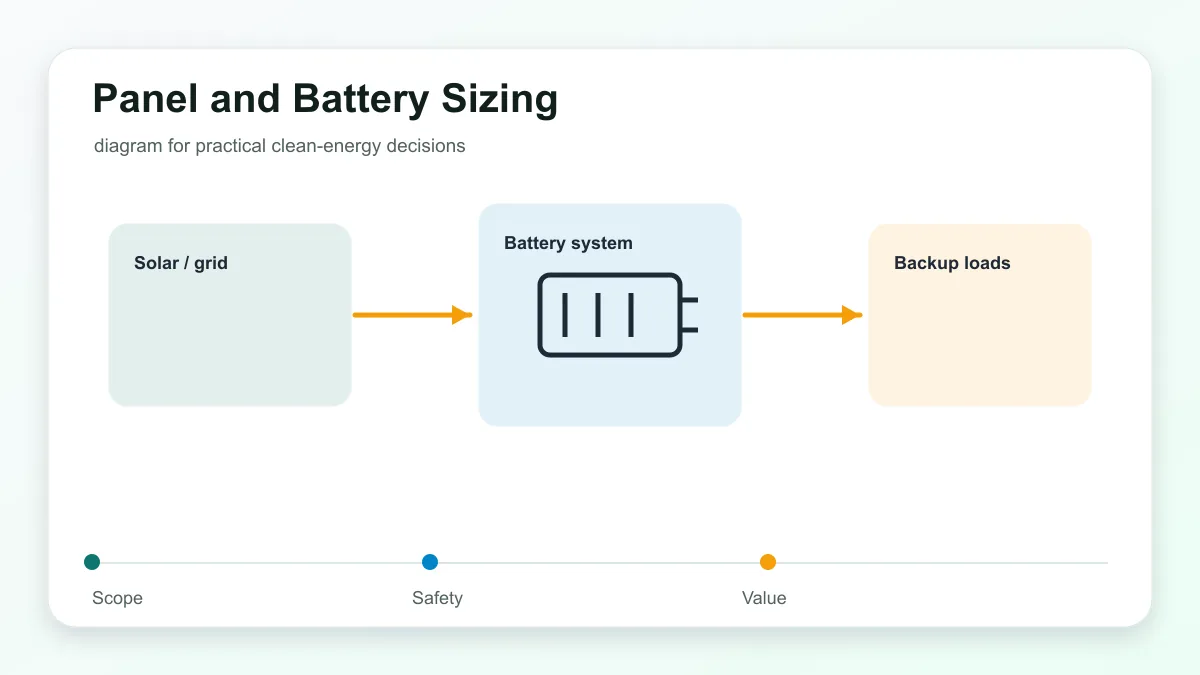
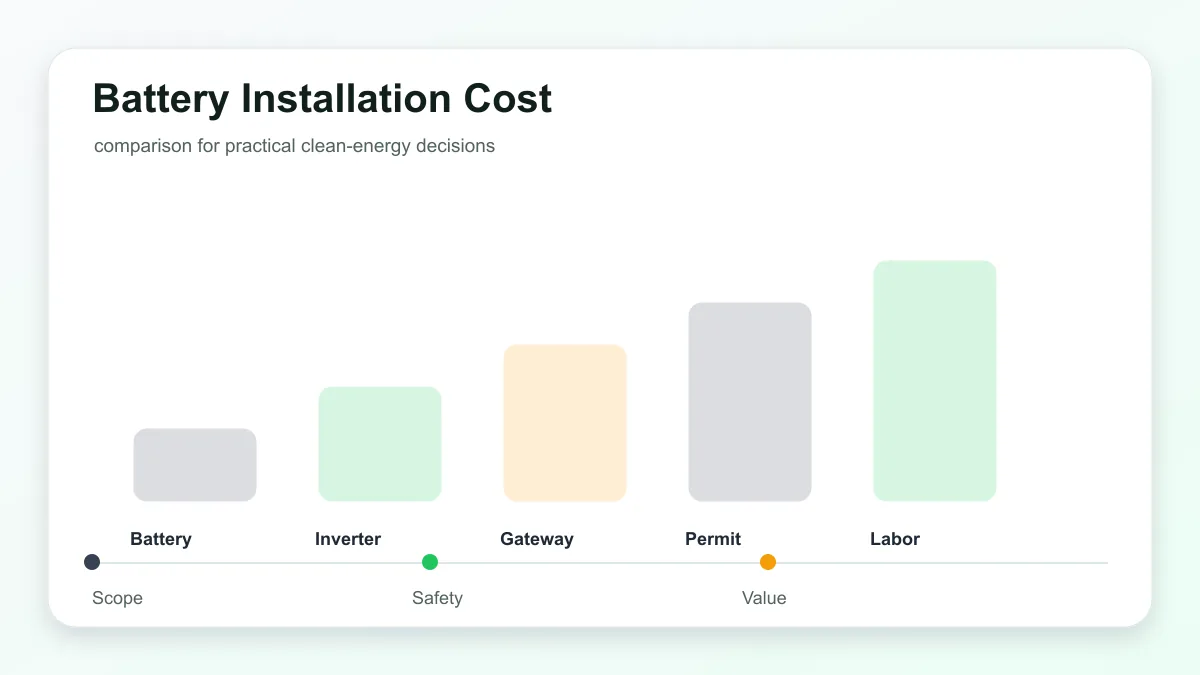
A home battery quote should separate the battery module, hybrid inverter or battery inverter, backup gateway, critical-loads panel, electrical labor, permit fees, monitoring, and commissioning. Tesla Powerwall, Enphase IQ Battery, FranklinWH, Sonnen, BYD Battery-Box, and Generac PWRcell are not interchangeable line items because they differ in usable capacity, continuous output, surge rating, ecosystem lock-in, and warranty conditions.
The most common cost mistake is comparing nameplate kilowatt-hours instead of usable kilowatt-hours. A 13.5 kWh battery with 90 percent usable capacity does not provide the same real backup value as a larger system limited by inverter output or reserve settings. For backup use, also compare continuous kilowatts, motor-start surge capability, and whether the system can run the well pump, HVAC blower, refrigerator, network equipment, and garage circuit at the same time.
Ask the installer to price three scopes: self-consumption only, partial-home backup, and whole-home backup. The battery module may be the same, but the switchgear, load panel work, and commissioning time can change sharply. If the quote includes a service-panel upgrade, confirm whether that upgrade is required for code, backup scope, solar interconnection, or future EV charging. Those are different decisions.
References
Related Articles